Welcome to Jersey City Bird Control: Prevention and Removal of Unwanted Birds
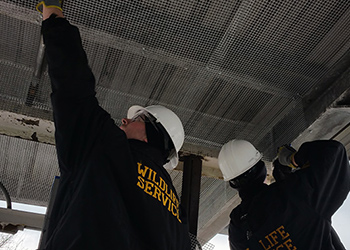
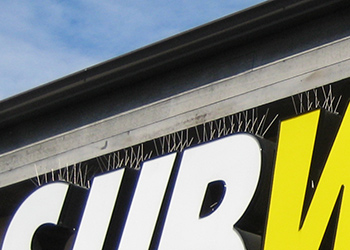
Our company specializes in resolving problems caused by birds in Jersey City, New Jersey, both residential and commerical. We handle bird species such as pigeons, starlings, grackles, sparros, and even Canada Geese and woodpeckers. We generally don't kill birds - we prevent them from causing problems. Most commonly, this means that we install barriers that prevent them access to your building or property, or anti-roosting devices that prevent them from landing, nesting, or roosting on your home, store, building, or anywhere. We use netting, needle strips, shock track, and more. We do offer trapping in some cases, and removal of birds from warehouses, grocery stores, or other commerical or industrial buildings by netting or sometimes pellet shooting. We have a wide variety of tools and methods for solving every manner of bird problem. Call us at 201-243-4657 to discuss your bird problem today.Our Work
Full Range of Bird Control Services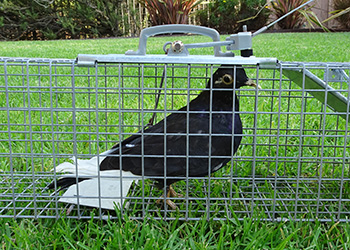
More About Us Jersey City Bird Control:
There are many reasons why the locals have remained our loyal customers over the years. We provide real bird control solutions with no shortcuts. Compared to other companies that will apply repellents that will not work, we will help you determine the how's and why's of your bird invasion problem. Our services focus on helping businesses and homeowners in preventing similar infestation. We are confident with our work; we provide our customers with a guarantee and warranty. Should there be an incident when the bird returns during the time mentioned in the contract, we will return and fix it with no extra charges. We are dedicated to safety; we protect your family, brands, and the environment. We will only use eco-friendly measures and a humane approach to keep you and these animals safe. As a company that has been in the industry for more than a decade, we understand that our service will not end after the birds are gone. We are aware that they may leave microorganisms and parasites that can lead to health problems. Our technicians are also required to complete training related to sanitation and decontamination. Now that most of the viruses are coming from wild animals, we want you to know that we are equipped with potent cleaning products and materials that are effective in keeping your house free from viruses and germs causing diseases.Pigeon Rescue: Who to Call & How to Do It
There's bad news on the horizon if you're hoping that you can rehabilitate a sick or injured pigeon yourself, with whatever you have at home. This is even more so the case if you come across a nest of squabs or baby pigeons.
Pigeons need pretty specific care, and they'll need even MORE specific care if they have a physical injury or affliction. There is a chance that you could raise a relatively young pigeon from the orphan stage, releasing it back into the wild at a later day, but the prognosis for that hand-reared pigeon isn't good. Being more tamed than the rest, it might not be able to establish itself with a group or flock, and that will leave it more vulnerable, particularly to predators.
If you come across a sick or injured pigeon, you could search online for something like, "pigeon rescue near me". You'll get a good idea of how many rehabilitation centers are close by, and whether or not it is worth your time trying to attempt it. If there isn't a rehabilitator close enough for you to work with, you'll either need to travel a great distance to find one, or you'll need to do the job yourself. At this stage, it is down to you whether or not the job is worth it, although it does pay to bear in mind that the bird could be feeling a great deal of pain.
If a wildlife removal expert were to find a pigeon that couldn't fly and was in need of rescue, the situation would be evaluated. If there wasn't an experienced pigeon handler in the area, it would be a kinder approach to put that pigeon down. If keeping it alive is going to just prolong the pain it goes through, it would be considered cruel and inhumane to try. In many instances where inexperienced handlers have attempted to release a rehabilitated pigeon, the pigeon has died. These wild birds are not meant to be tamed or raised by humans, and it puts them at a massive disadvantage when the time comes for them to fend for themselves.
If you HAVE found a rehabilitator close that will take on your poor pigeon, you will need to first get that pigeon into a box or similar. Wear gloves as you do this -- the thicker the better. Diseases are easily spread by birds to humans by way of direct contact, as well as contact with feathers, feces, and nesting material.
Something soft in the box, such as an old towel or blanket, can be used to make the bird safe and to keep it warm. This also gives the bird something to grab hold of as it and you are on the move. Otherwise, it could easily slide from one end of the container to the other as you're moving it around, and this could cause further injury to an already-injured pigeon.
The chances of you finding somewhere or someone to take in an injured pigeon are rare, mostly because the animal is considered to be a disease-spreading pest, in almost all places across the globe. Especially when you're talking about REAL pest pigeons -- feral pigeons.
The most natural way to let this situation play out, is to let nature take its course. An injured pigeon would become food to another animal, out in the ‘wild', and there are a few other animals that will feast on a feral pigeon given half the chance. Unfortunately, the sight of a dead/dying pigeon can be too distressing for some, and it's not the kind of thing you or your kids want to see in the back garden or on the sidewalk.
Also read our other bird tip: How to inspect a house for pigeon entry holes
We have the most experience in Jersey City at understanding the nuisance birds of New Jersey. Our 7 years of experience in the field ensures excellent results.
We pride ourselves on the quality of our bird control work. Our work is professional grade and long lasting, usually for the life of the building.
We are fully New Jersey licensed. We carry the correct safety equipment, and operate in a safe and professional manner to keep your building and people safe.
Call us at 201-243-4657 to discuss your bird problem and our process. We are always responsive by phone. We can usually schedule next-day appointments, and provide written estimates for all our bird work.
Thank you Jersey City Bird Control for keeping the pigeons off of my storefront. My sidewalks are clean now!
These guys were the only ones who could get a sparrow out of my clothing store. Thank you!
Your goose abatement program has kept my golf course dropping-free. I recommend Jersey City Bird Control.